The Town of Ramapo is in search of lifeguards. Must be at least 15 years old and have completed 10th grade. Willing to train qualified candiates. Contact bridgesm@ramapo.org for more information.


The Town of Ramapo is in search of lifeguards. Must be at least 15 years old and have completed 10th grade. Willing to train qualified candiates. Contact bridgesm@ramapo.org for more information.

ROCKLAND COUNTY, N.Y. (May 26, 2021) – Rockland Community College announced today that Dr. Michael Baston, President, has been selected to join the Education Design Lab’s Designers in Residence program. As a part of the program, Dr. Baston will be building on identifying the jobs of the future and developing curriculums and career skill pathways that meet the needs of community and commerce partners, and continuing to develop the RCC initiative of Steps Beyond Statements to close equity gaps.
Spanning a diverse cross-section of communities, institutional positionality, and lived experience and expertise, the Designers in Residence will work together as a design team to co-create a model for colleges to be regional change agents to close economic and racial opportunity gaps as we move into a post-COVID economy.
“I am honored to be selected to be a Designer in Residence. This presents a unique opportunity to learn from innovators across the country and contribute the insight we have amassed at RCC to help others develop the institutions that they want to see serving their communities. RCC has a long-standing commitment to be a catalyst for economic growth in our region, offering thoughtfully designed programs and partnerships that are responsive to both student and workforce needs. But we can always do more to support students, which includes learning from other innovators across the country,” said Dr. Baston. “Within the cohort, we will be able to leverage our collective expertise to develop new insights regarding how higher education can best serve students today and in the future. I look forward to those insights impacting not only our own students, but students across the country.”
Dr. Baston intends to share RCC’s Steps Beyond Statements program which dictates that community colleges must first offer a safe and welcoming environment, create strategic partnerships between the college and the community, and take advantage of organizational resources and collaborative leadership to ensure equitable opportunities and outcomes for all students.
In 2021, 22% fewer students enrolled in higher education than prior to the COVID-19 pandemic, a number that increases to 30% for students from low-income high schools. Simultaneously, 42% of jobs lost during the pandemic may disappear forever, requiring postsecondary education to reimagine how learners are prepared to enter the workforce. Across New York the number of students applying to attend one of the State University of New York’s 64 campuses fell by 20 percent this year amid the coronavirus pandemic. One of the major objectives of the Workforce Development Board of Rockland County is to strategically direct training resources to in-demand industries that are driving economic development in the County. The four key industries of focus are Advanced Manufacturing, Data Technology, Biomedical, and Hospitality and Tourism.
To help address these disparities, Designers in Residence will leverage their collective expertise to co-create a framework that centers on the needs of their learners within a rapidly evolving economy and provide the start of a roadmap for other institutions and innovators seeking to build and scale this system.
“We hope to emerge from this year with design tools that will position the scores of learner success partnerships around the country to seize what we all believe is an innovation moment, coming out of the pandemic,” said Kathleen deLaski, CEO of the Education Design Lab. “Colleges recognize that their roles are evolving along with learner views about degrees and employer’s needs, and with a heightened urgency around what it will take to break down racial and economic barriers to open up livable wage futures for all.”
Other members of the Designers in Residence cohort include:
Bonita Brown, Vice President and Chief Strategy Officer, Northern Kentucky University
Ahmad Ezzeddine, Associate Vice President of Educational Outreach and International Programs, Wayne State University
Chanel L. Fort, Director of Academic Innovation and Learning Strategist, Fortified Learning Solutions, Stillman College
Rose Rojas, Interim Director of Workforce Strategy, Maricopa Community College
Adrian Haugabrook, Executive Vice President and Managing Director, Social Impact Collective, Southern New Hampshire University
Lisa Larson, President, Eastern Maine Community College
Cameron McCoy, Incoming Provost, Shenandoah University
Nicole McDonald, Assistant Vice President, University of Houston
Jairo McMican, Dean of Student Learning/Director of Equity and Pathways, Central Carolina Community College
Ian Roark, Vice President of Workforce Development and Strategic Partnerships, Pima Community College
Stacy Townsley, Vice President of Adult Strategy and Statewide Partnerships, Ivy Tech Community College
This program is funded by the Bill & Melinda Gates Foundation and views expressed by the program do not necessarily reflect positions or policies of the foundation. Learn more about the program here.
About Rockland Community College, State University of New York
Rockland Community College, State University of New York, offers a safe, supportive learning environment for thousands of students from diverse backgrounds who appreciate small class sizes and personal attention from a distinguished, award-winning faculty that includes Fulbright scholars and SUNY Distinguished Professors. Thanks to the school’s affordable tuition, students who begin their career journey at RCC and then transfer to a four-year college can save up to $100,000 on their education. RCC is also proud to provide career training and professional development to adult learners looking to change careers or upgrade their skills through its new Career Skills Academy. More information can be found at www.sunyrockland.edu.
About Education Design Lab: Education Design Lab is a national nonprofit that designs, tests, and implements unique higher education models and credentials that address the rapidly changing economy and emerging technology opportunities. The Lab demonstrates where technology, rigor and design can improve opportunity for historically underserved learners to maximize their potential in the higher education system.
Education Design Lab works across disciplines and alongside schools, employers, entrepreneurs, government, foundations, nonprofits and innovators. The organization has significant experience managing national and local learning cohorts, working with organizations such as The Michael and Susan Dell Foundation, the United Negro College Fund, Walmart, American Council on Education and the ECMC Foundation. Learn more: www.eddesignlab.org.
Qualifying eating establishments should submit applications by theMay 24th deadline
WASHINGTON – Administrator Isabella Casillas Guzman announced that eligible eating establishments have until Monday, May 24, 8 p.m. ET, to submit applications to the Restaurant Revitalization Fund.“If our nation’s food and beverage industry is going to fully recover, we must ensure as many of the hardest-hit businesses get the economic aid they need,” said Administrator Guzman. “We are committed to creating easy to navigate programs and removing barriers that have kept many of our nation’s smallest businesses from accessing these crucial economic lifelines. The SBA will continue to be as entrepreneurial as the small businesses we serve, and we will continue to work as fast as possible to deliver the relief our businesses need so urgently.”
“The numbers speak to the commitment SBA made to educating owners and operators through their work with the Association, our state partners, and other industry support organizations,” said Tom Bené, President & CEO of the National Restaurant Association. “The funds that have already been distributed will help accelerate the recovery of thousands of restaurants and bring much-needed capital to communities across the country.”
The $28.6 billion Restaurant Revitalization Fund signed into law by President Joe Biden established an initial $5 billion set-aside established by Congress for applicants with gross receipts not more than $500,000. To further ensure an equitable distribution of funds, Administrator Guzman created two additional funding allocations to ensure the smallest of the small restaurants and other eating establishments have equitable access: 1) $500 million for applicants with 2019 gross receipts not more than $50,000, and 2) $4 billion for applicants with 2019 gross receipts between $500,000 and $1,500,000. In the first two weeks of the RRF program, and after 600 targeted community outreach events in multiple languages, SBA has received from priority groups:
Designed to ensure the smallest of small eating establishments get the relief needed, set-asides continue a commitment to an equitable distribution of funds to hard-hit communities. Because SBA still has potential set-aside funding available for eligible establishments with 2019 annual revenue of not more than $50,000, it will keep the application portal open until Monday, May 24, 8 p.m. ET. While all qualified restaurants may submit applications, more than $220 million of a $500 million set-aside remains in the Restaurant Revitalization Fund (RRF). Eligible establishments that meet this revenue standard are encouraged to apply through SBA-recognized point-of-sale vendors or directly via the SBA online application portal.
To date, the RRF program has received more than 303,000 applications representing over $69 billion in requested funds, and nearly 38,000 applicants have been approved for more than $6 billion. Of the overall submitted applications, 57 percent came from women, veterans, and socially and economically disadvantaged business owners. During the first two weeks of the program, SBA has received applications from:
For those interested in applying to the Restaurant Revitalization Fund, visit sba.gov/restaurants.

NY Green Bank is pleased to announce the release of a new financing pathway for multifamily affordable housing electrification and electrification-readiness. The launch of this request for proposals (RFP) aligns with NY Green Bank’s target of $150 million in affordable housing investment announced by Governor Andrew M. Cuomo in July 2020 and supports NY Green Bank’s overall strategy to prioritize energy efficiency and building electrification investments in historically underserved communities. This new pathway to engage with NY Green Bank supports an equitable transition to a clean energy economy and the delivery of at least 35 percent with a goal of 40 percent of the benefits of clean energy investments to disadvantaged communities as outlined in the Climate Leadership and Community Protection Act. NY Green Bank’s RFP 18 invites property owners and developers, energy service companies and equipment manufacturers, capital providers, and other market participants to submit proposals for investment in the construction or retrofit of multifamily affordable housing buildings to high levels of energy performance in New York State. This investment approach is backed by:Products, terms, and rates that are calibrated to the needs of the sector and based on comparable transactions in the market;Beneficial impact to residents weighed as a key investment goal; andDedicated senior team with affordable housing investment expertise.RFP 18 is now accepting proposals and will remain open with submissions evaluated on a rolling basis. To learn more, register for “Get to Know RFP 18”, an informational webinar featuring Vice President Tibita Kaneene on July 14 at 12pm ET. NY Green Bank recognizes that high-performance multifamily affordable housing is one of the many sectors in which clean energy and sustainable infrastructure investment is needed in the State’s historically underserved communities. Other investment RFPs, including RFP 1 , remain open to proposals for projects that serve disadvantaged communities but do not fit within the scope of this opportunity, such as rooftop solar installations on affordable housing properties, high performance non-residential buildings, and community solar that will benefit low- to moderate- income subscribers. As part of its broader investment approach, NY Green Bank is considering benefits to disadvantaged communities when evaluating proposals under all solicitations. This includes strong interest in supporting projects outside of affordable housing, such as clean transit solutions and high-performance retrofits to community facilities, that will deliver essential benefits to disadvantaged New Yorkers. If you have any questions related to this solicitation, please contact Clara Grantier, Analyst on NY Green Bank’s Strategy, Impact, & Investor Relations team, at clara.grantier@greenbank.ny.gov. Thank you for your continued partnership and interest in NY Green Bank’s financing options. Click Here to Submit a Proposal Under RFP 18 |
| About NY Green BankNY Green Bank is a $1 billion State-sponsored specialized financial entity working with the private sector to identify, address, and alleviate market barriers preventing the widespread deployment of clean energy across New York State. NY Green Bank uses demonstrated financing tools to promote self-sustaining markets, while enabling private sector capital providers to expand the frontiers of current commercial clean energy investment opportunities. NY Green Bank is currently working with some of the most prominent global financial institutions and regional banks, as well as developers, in New York to advance the State’s clean energy marketplace. |
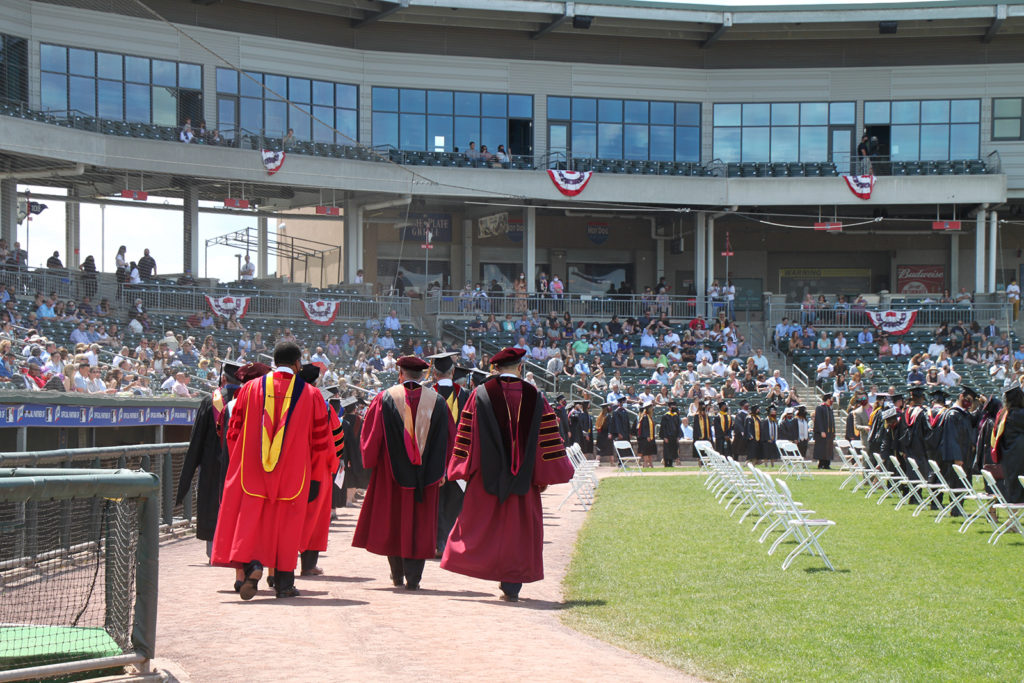
(SPARKILL, N.Y. — May 20, 2021) — St. Thomas Aquinas College (STAC) held its 64th Commencement Exercises in-person on Tuesday, May 18, 2021, at Palisades Credit Union Park in Pomona, NY, the baseball home of the New York Boulders — and the STAC Spartans. The excitement was palpable while over 300 students were celebrated and awarded master’s, bachelor’s, and associate’s degrees on a beautiful spring day.
It was an honor to have as our guest, Dr. Philip O. Ozuah, MD, Ph.D., President and Chief Executive Officer, Montefiore Medicine, who delivered an inspiring and poignant Commencement address to the Class of 2021, sending them off with words of wisdom as they begin their career journeys during this challenging time. In his closing statement, Dr. Ozuah said, “Always strive for excellence and go boldly into the future and make a name for yourself.” Dr. Ozuah was also bestowed The Honorary Doctor of Public Service degree by STAC President, Kenneth D. Daly.
President Daly shared kind words with each graduate, and stated: “While the history books will document the devastating COVID health and economic impacts that have continued into 2021, I will always remember how my first graduating class navigated these challenges and safeguarded the entire STAC community. I will also remember how, together, we launched our Center for Social Justice and began to listen and learn from one another in our commitment to ensure that all voices are heard and that we become part of the solution in the turbulent days ahead. I know you will be your best self … and I know you will make an impact. You have made an impact on me … and you have left an indelible mark here at the College.”
Salutatorian, Niamh Ellen McKevitt, and Valedictorian, Daniel Alan Monarchi, spoke to the graduating class and shed light on their fulfilling time at the College.
Student Class Service Awards included the Gold Key and Silver Key Service Awards—the Gold Key Service Award was presented to Michael Paul Gonoud, Abagaile Therese Kimbrell, Samuel Harris Naveran, and Matthew Ray Quinones; the Silver Key Service Award was presented to Nicholas Austin DiPietro, Mary Elizabeth Dristle, Gianna Philomena Galu, Hayley Nicole Kousoulas, Kristina Nicole Lodato, Christina Carla Maretzo, George Meizah Nkrumah, Michael James Rappo, Alexandra Rose Presti, Sadiki E. St. George, and Paige Louise Toothaker. The Terence Cardinal Cooke Award was presented to Anabel Garcia, who has demonstrated outstanding and meritorious service; the Jon Roberts Award was awarded to Felicity Erica Popovich, for earning the highest academic excellence in Literary Studies; the Sister Regina Rosaire Dolan Award was presented to Taylor Marie Gorman, for having the highest academic excellence in the School of Education graduate program; the Francis Cardinal Spellman Award was given to Hayley Nicole Kousoulas and Daniel Alan Monarchi for the highest academic excellence in the undergraduate program; and the Betty LaSala Award was given to Abagaile Therese Kimbrell for earning the highest academic excellence in the Sciences.
In addition to the Special Awards, students who completed the Honors Program of Study and Aquinas Leaders Program were officially recognized for their admirable accomplishments.
The STAC community is thankful to the College’s dedicated faculty, staff, students, friends, and all who came together to celebrate our graduates this week. We are especially proud of the Class of 2021 for their hard work, tenacity, and resilience while adapting to extraordinary conditions over the past year. Congratulations to the St. Thomas Aquinas College Class of 2021!
St. Thomas Aquinas College is an independent liberal arts college located on 72 acres in Rockland County, NY, which provides education at the undergraduate and graduate levels. The College’s approximately 2,000 full and part-time students can choose from more than 100 different majors, minors, specializations, and dual degree programs across three Schools: Arts & Sciences, Business, and Education. The College is recognized by U.S. News & World Report in the Top-Tier for Regional Universities, by Colleges of Distinction in both its New York and Catholic editions, by Affordable Colleges Online as a top College in New York for Return on Investment, and is included as a Military Friendly School. St. Thomas Aquinas College is accredited by the Middle States Association of Colleges and Schools; its School of Education is a candidate for accreditation by the Association for Advancing Quality in Educator Preparation (AAQEP), and its School of Business is accredited by the International Accreditation Council for Business Education (IACBE). For more information, visit www.stac.edu.