
Brought to you by the Pearl River Chamber

 Stony Point Town Hall
74 East Main Street
Stony Point, NY 10980
(845) 786-2716
www.townofstonypoint.org
Brought to you by the Pearl River Chamber
FORT MONTGOMERY, NY – In a swift response to the extensive damage caused by torrential rains in early July, the Popolopen Bridge over Route 9W in Fort Montgomery was reopened on Friday, less than four weeks after the storms.
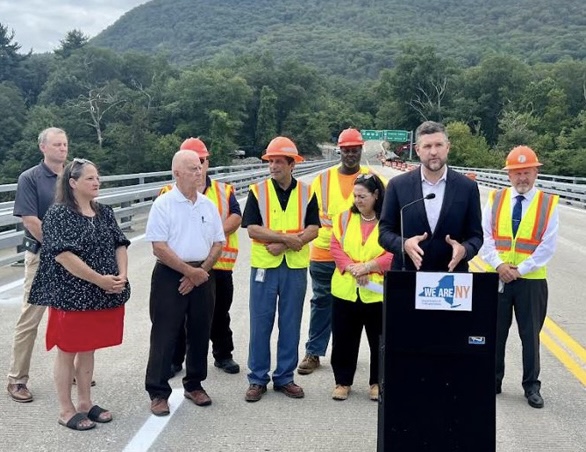
The destruction to the bridge caused significant disruptions to traffic, local businesses, and hampered the efficiency of first responders. State transportation department engineers and contractors designed and built a new support system for the structure, using a geosynthetic reinforced fill-type retaining wall system to stabilize the soil and provide a stable foundation for the bridge.
This essential link, connecting the roadway to the Bear Mountain Bridge Circle, allows access between West Point and the Bear Mountain Bridge. Governor Kathy Hochul praised the speedy restoration, emphasizing that the bridge’s reopening “will make travel easier between West Point and destinations to the south… in record time and long before tens of thousands of travelers arrive to see our Army Black Knights begin their season.”
Congressman Pat Ryan (D, NY-18) and State Senator James Skoufis (D, Cornwall) also expressed their commendation for the quick response and recovery efforts, with Skoufis expressing confidence “that our communities will come back stronger as the recovery effort proceeds in earnest.”
In addition to the Popolopen Bridge, state crews and contractors worked diligently to repair and reopen several other storm-damaged roads in Orange, Rockland, Westchester, and Dutchess counties. Roads restored include sections of U.S. Route 9W, State Route 32, Palisades Parkway, and various others, enhancing regional connectivity and easing the burden on travelers throughout the Lower Hudson Valley.
NEW CITY, NY, – Summer is here, and with it comes plenty of fun times spent in the water. Unfortunately, whether it’s in your backyard or the local community pool, a lake, or the beach, the danger of drowning is present wherever families spend time in the water.
Drowning can happen to anyone in seconds, any time there is access to water. The Rockland County Department of Health recommends you follow these important tips from the Centers for Disease Control and Prevention (CDC) to help prevent drowning deaths, injuries, and the often life-long disabilities from near-drowning:
Also, if you have a backyard pool, remember to have a cell phone, emergency numbers, a first-aid kit, rescue equipment, and CPR instructions by the pool. For additional important water safety tips from the CDC, visit www.cdc.gov/drowning/prevention/index.html.
Albany, NY – New York State Senator Pete Harckham completed his first legislative session as chair of the Senate Environmental Conservation Committee (EnCon) recently with 89 bills passed out of committee, 44 of which passed in the Senate and 30 in both houses that now await the governor’s signature. Harckham, as committee chair, also led the budget table during the negotiations for the FY2024 Budget and ensured critical funding for a number of initiatives.
“In my first session as chair of the Senate Environmental Conservation Committee, it was important to coordinate our work with the goals relating to climate action, protection of natural resources and promoting environmental justice and public health,” said Harckham. “I truly appreciate my colleagues’ efforts, and thank them for advancing some of the most important legislation of the session. As chair of this committee, I endeavored to facilitate the work of my talented colleagues, doing what I could to help their bills succeed. We will continue to press on with safeguards that protect our environment for the sake of our planet and future generations.”
Important bills to come out of the Environmental Conservation Committee and pass the State Senateregarding climate action, with lead Senate sponsors in parentheses include:
● S.1292 (Sen. Parker) develops a clean fuel standard statewide to reduce greenhouse gas emissions in the transportation sector;
● S.227B (Sen. May) identifies sources of a class of pollutants known as polyfluoroalkyl substances, or PFAS, in the waters of the state through the creation of an annual testing requirement for all permitted facilities and industrial users discharging waste in the state;
● S.724 (Sen. Serrano) prohibits the lease of state forests and wildlife management areas for the purpose of gas production;
● S.1413 (Sen. Hinchey): Establishes the position of Catskill Park coordinator within the Department of Environmental Conservation (DEC);
● S.2129A (Sen. Krueger) establishes a climate change adaptation cost recovery program that will require companies responsible for producing greenhouse gas emissions to help fund infrastructure investments aiming to protect communities against the effects of climate change, and with compliance for prevailing wages included; and
● S.2994A (Sen. Harckham) prohibits fuel oil, grade four in any building or facility in the state after July 2026.
Important bills to come out of the Environmental Conservation Committee aimed at protecting our natural resources that have passed both houses include:
● S.1856A (Sen. Hoylman-Sigal)—the landmark Birds and Bees Protection Act—prohibits the sale of most of the neonic pesticides and pesticide coated seeds;
● S.1688 (Sen. Sanders) authorizes the use of waste tire management and recycling fee funds for demonstration projects of tire reuse in agricultural settings and for conducting analysis of waste tire reuse opportunities;
● S.1725A (Sen. Harckham) protects Class C streams and fragile drinking water supplies;
● S.6604 (Sen. Harckham) permits geothermal boreholes at depths beyond five hundred feet requirements;
● S.3365 (Sen. Harckham) requires disclosure of insurance information from pipeline developers; and
● S.5957 (Sen. Harckham) prohibits the application of pesticides to freshwater wetlands.
Important bills to come of the Environmental Conservation Committee promoting environmental justice and public health include:
● S.6893 (Sen. Harckham, passed in both houses) introduced to protect communities along the Hudson River that are concerned radioactive wastewater dumped into the river as part of the decommissioning process will have both short- and long-term effects on local real estate values and economic development.;
● S.5728A (Sen. Harckham, passed in Senate) assists municipalities with water quality improvement of water bodies within the municipality managed by lake associations;
● S.3419A (Sen. Mannion, passed in Senate) establishes the bottle redemption fraud task force; and
● S.5186A (Sen. Mayer, passed in Senate) requires the state Department of Environmental Conservation (DEC) to implement permit regulations and guidance regarding shoreline management.
Important funding to come out of the Environmental Conservation Budget Table includes:
● $400 million for maintaining the Environmental Protection Fund for capital projects that protect the environment and enhance communities, including funding environmental justice, municipal parks and recycling, and land acquisition;
● $500 million for the Clean Water and Infrastructure Act;
● $20 million for Zoos, Botanical Gardens, and Aquaria;
● $15.3 million for Climate Resilient Farms; and
● $19 million for Municipal Recycling.
Adrienne Esposito, executive director of Citizens Campaign for the Environment, said, “Even during a short legislative session, protecting our environment remained a top priority. Under the leadership of Senator Harckham, a number of critical environmental bills were advanced in the New York State Senate. These bills protect our water quality and pollinators, reduce solid waste, and eliminate toxics. Several of these bills, including wetlands protection and protection of pollinators, are awaiting the Governor’s signature. We will continue to work with our elected leaders in the following months to ensure progress advances. Senator Harckham’s effective, steadfast work will benefit all New Yorkers.”
Roger Downs, conservation director of the Sierra Club Atlantic Chapter, said, “In his first year as Environmental Conservation Committee Chair, Senator Harckham has demonstrated a keen ability to broker agreements on solutions to some of New York’s toughest environmental problems. Part of what makes Senator Harckham so effective is his commitment to advancing policies that actually work for a wide range of stakeholders across the political spectrum. Whether addressing the scourge of harmful pesticides, protecting our irreplaceable water resources or combating the worst impacts of climate change, we know we have an environmental champion who will always help us navigate to a better place.”
Jeremy Cherson, senior manager of Government Affairs for Riverkeeper, said, “The legislation passed through the Senate Environmental Conservation Committee this legislative session will, once signed by the Governor, have a lasting, generational impact on New York. These include, preventing radioactive discharges into the Hudson River from Indian Point, defending our streams from the Supreme Court’s constraining of the Clean Water Act, prioritizing living and adaptable shorelines that can withstand a changing climate, and protecting our pollinators and communities from toxic pesticides. This Senate Environmental Conservation Committee, under the leadership of Senator Pete Harckham, made substantial progress on many of New York and the Hudson River’s most pressing environmental challenges.”
Patrick McClellan, policy director for the New York League of Conservation Voters, said, “The New York League of Conservation Voters commends Senator Pete Harckham and the Senate Environmental Conservation Committee for advancing many strong environment policies throughout the 2023 legislative session. Whether it was their historic vote on the Clean Fuel Standard, the Birds and Bees Protection Act, the Class C Streams bill, or enabling the state to produce renewable energy faster with geothermal regulatory relief, Sen. Harckham and his fellow committee members demonstrated invaluable leadership in championing policies to fight climate change and create a more sustainable future for all New Yorkers.

Eisha Sarmad, a recent graduate of Rockland Community College, has been chosen as one of the 60 high-achieving community college students in the nation to receive the Jack Kent Cooke Foundation’s Undergraduate Transfer Scholarship. This prestigious scholarship, which is highly competitive, aims to help Cooke Scholars complete their undergraduate education with minimal debt.
Please see the attached release for more details. Thank you.